
How to Keep Container Plants Alive in a Heatwave
- A UK heatwave is at least three consecutive days at or above a county threshold, which the Met Office sets between 25°C and 28°C depending on location.
- The RHS advises watering pots in the early morning, when the compost is dry about a third of the way down, and says summer containers may need water every day or every other day.
- Oregon State University Extension reports that plant growth slows once temperatures stay above 90°F (32°C), and that wilting plants often recover when the temperature drops.
- Watering cans and buckets are generally still allowed during a UK hosepipe ban, and breaking a ban can bring a fine of up to £1,000.
- The RHS says grey water from baths, showers and washing-up can go on ornamental plants within 24 hours, and ideally not on edible crops.
Wilting in the afternoon is usually not the same thing as dying. Many container plants droop in the hottest hours and recover once the heat drops. The question that matters is whether yours have perked up by evening.
Is a wilting plant dying, or coping?
A pot is a hard place to be in hot weather. The compost heats up and dries far faster than ground soil, and a balcony is often a bright, reflective, windy box. The RHS notes that south and west-facing pots dry fastest, and that terracotta and metal containers speed things up.
Oregon State University Extension describes leaf rolling and cupping as a plant reducing its surface area to lose less moisture. It adds that wilted plants may recover when temperatures drop. University of Minnesota Extension puts it bluntly: heat alone can cause wilting even when moisture is adequate.
So check twice. Feel the compost at midday, and look again in the evening once the sun is off the balcony. A plant that is upright again by dusk was coping. One that is still flat at 9pm has dry or damaged roots and needs help tonight.
What is the ten-minute rescue?
This is the whole job for a small balcony. Do it in the evening if plants are flat, or first thing in the morning if a hot day is forecast.
1. Lift the pot
Weight tells you more than the surface does. A pot that feels feather-light is dry all the way through. One that is heavy but wilting has a different problem, covered in the table below.
2. Dunk the driest pots
Bone-dry compost sheds water, which runs down the inside of the pot and out of the holes. The RHS suggests dunking small pots in a bucket or tub of water. Leave them until the compost is wet through, then let them drain.
3. Move small pots into afternoon shade
Anything under about 20cm (8in) across holds very little water and is the most vulnerable thing you own. Minnesota Extension advises shifting pots to morning sun and afternoon shade during heat.
4. Group the pots and mulch the surface
The RHS lists grouping pots together and applying mulch among its water-saving measures for containers. Pots shade each other's sides, and a covered surface loses less water.
5. Leave the scissors alone
Crisp leaves are ugly, but Oregon State advises against pruning or fertilising during extreme heat. Scorched foliage still shades what is beneath it. Tidy up once the weather breaks.
When should you water, and how much?
Early morning. The RHS gives the reason: less evaporates, and plants can use the water through the day. Minnesota Extension narrows it to 5am to 9am. The RHS accepts early evening as second best for pots, and in serious heat small containers may need both.
Check before you pour. The RHS test is a finger pushed about a third of the way down the pot, watering only if it is dry at that depth. In a dry summer that can mean every day or every other day. Minnesota suggests daily, sometimes twice, for containers in a heatwave.
Then water slowly and thoroughly. The RHS method is to fill the pot to the rim, let it soak in and repeat once. Frequent light splashes wet only the top few centimetres, and Oregon State prefers deep watering to shallow for that reason.
A point where the advice differs
US extension guides, Clemson's among them, say to water until it runs from the drainage holes. The RHS says to stop before that happens, to save water and avoid washing nutrients out. Both aim to wet the whole root ball. During a drought the RHS version wastes less, and a saucer catches the difference.
If you use saucers in summer, the RHS advises emptying them a few hours after watering so the compost does not stay saturated. Aim water at the compost, not the leaves. Basil in particular is best watered in the morning, because the RHS says it hates having wet roots overnight.
Is it heat stress or overwatering?
Both can make a plant wilt, and the second is more common than people expect in a heatwave, because a drooping plant invites another can of water. The RHS calls overwatering the most common cause of loss of container plants. Check the pot's weight and the compost before deciding.
| What you see | More likely heat or drought | More likely overwatering |
|---|---|---|
| Wilting | Worst mid-afternoon, recovers by evening or after watering | Constant, including first thing in the morning |
| Pot and compost | Pot feels light; compost dry a third of the way down, shrunk from the sides | Pot feels heavy; compost wet and may smell sour; saucer full |
| Leaves | Rolled or cupped; dry, brown edges; bleached patches on the sunny side | Yellowing from the bottom up; soft, limp growth |
| Flowers and fruit | Blossom drop on tomatoes and peppers; lettuce and spinach bolting; pale, hard patches of sunscald on fruit | Little flowering; stems soft or dark at the base |
| What to do | Water deeply at dawn, shade, mulch, wait | Stop watering, empty the saucer, move under cover from rain, let it dry |
The overwatering column reflects common horticultural experience more than a single cited source, so use it as a prompt to check the compost. The heat column follows the Oregon State list: leaf rolling, wilting, dry leaf edges, blossom and fruit drop, bolting and sunscald.
How do you shade, move and mulch pots?
Shade in the afternoon is worth more than extra water. If a pot can be lifted, move it behind the balcony wall, under a table or against a north or east-facing wall for the duration. A plant that spends ten days in the wrong light is a recoverable problem, whereas one that has dried to a crisp is compost.
For pots too heavy to move, Minnesota Extension suggests temporary shade from lawn chairs, old sheets or 30 to 40% shade cloth. Keep fabric off the foliage and tie it down, because a sheet on a fifth-floor balcony is a sail. The same guide suggests double-potting, one pot inside a larger one, to insulate roots.
Mulch the compost surface with bark, gravel or straw. The RHS figure for borders is a layer at least 5cm (2in) thick. Minnesota suggests a 1 to 2 inch (2.5 to 5cm) top-up in heat, which is more realistic in a pot. Keep mulch clear of the stem.
Why is the basil dying while the rosemary is fine?
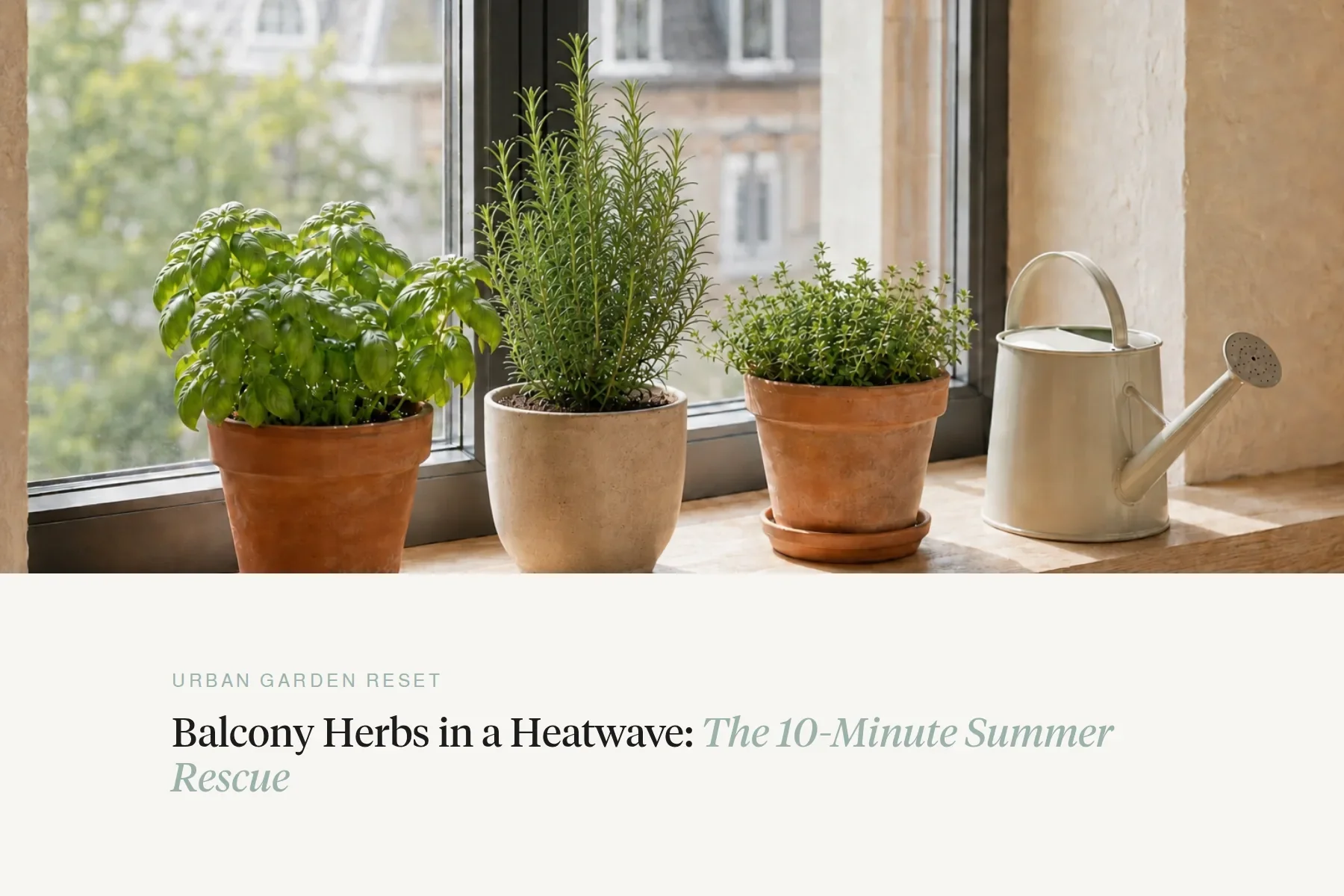
They want opposite things. Basil, mint, coriander, parsley and salad leaves are soft-leaved and thirsty. Rosemary, thyme, sage, oregano and lavender come from dry Mediterranean hillsides, and the RHS warns that rosemary must never sit in waterlogged compost. Water the two groups differently, even when they share a shelf.
The most useful change for the thirsty group is a bigger pot. More compost holds more water, which is the difference between watering twice a day and once. Supermarket basil comes in a pot it outgrows in a week, so its annual collapse says little about your gardening.
Fruiting crops have their own heat limits. Minnesota Extension reports that tomato flowers are likely to drop when days stay above 85°F (29°C) and nights above 70°F (21°C). The RHS says temperatures over 30°C (86°F) can reduce fruiting in chillies.
What should you do before going away?
Assume nothing on a hot balcony survives two weeks unattended, and plan from there. For a long weekend, shade and a deep soak are usually enough. For longer trips, a person or a timer is needed.
- Move every pot into the shadiest spot you have, even if it is the wrong place for that plant in normal weather.
- Group pots tightly, mulch them, and water deeply on the morning you leave.
- Stand the thirstiest pots in saucers for the trip. It breaks the usual rule about emptying them, and for a few days that trade is acceptable.
- For a week or more, ask a neighbour, and leave the watering can full beside the pots. The RHS advice for houseplants is the same: for absences longer than a couple of weeks, arrange for someone to water.
- If you travel often, the RHS suggests a self-watering system for containers. A tap timer and drip kit is the usual version, subject to the rules in the next section.
Indoor pots are easier. The RHS holiday care guide describes standing pots on capillary matting that trails into a sink or bath of water, or running a wick from a reservoir into each pot. Move them away from bright windows before you go.
What do hosepipe bans and drought restrictions allow?
In the UK, a hosepipe ban (formally a temporary use ban) stops you using a hosepipe or similar device to water a garden or plants, fill a paddling pool or clean a car. Water UK says buckets and watering cans are generally allowed. For a balcony of pots, a ban changes very little.
Rules vary by company, so check your supplier's list of exemptions before relying on a drip kit or timer. The Consumer Council for Water says breaking a ban could bring a fine of up to £1,000. People with mobility problems who are on their water company's Priority Services Register should not be covered by the ban.
In the US there is no national rule. The EPA's WaterSense programme notes that your water utility may ask you to limit outdoor watering or impose other restrictions during drought. Those usually take the form of set watering days or hours, so check your utility's or city's website.
The EPA also suggests reusing water from daily activities, such as the water you run while waiting for a shower to warm up. A bucket in the shower collects clean water that any pot can have, edible or not.
Can you use grey water on pots?
On ornamentals, yes, with limits. The RHS grey water guidance covers shower, bath, kitchen and washing machine rinse water. It says soil and potting compost are effective at filtering out soap and detergent residues. Apply it with a watering can, and use it within 24 hours so bacteria do not build up.
Edible crops are the exception, because of the risk of pathogens in the water. The RHS page on collecting and reusing water says to use grey water ideally only on ornamentals. If it must go on edibles, keep it to crops that will be cooked, so not salads.
Avoid water containing bleach, disinfectant, dishwasher salt or harsh cleaners. The RHS adds that softened tap water and dishwasher water are less useful because of their salts. In its trials, some plants showed salt stress after six weeks and benefited from a rinse through with tap water, so alternate if the dry spell drags on.
What officially counts as a heatwave?
The Met Office definition is at least three consecutive days with daily maximum temperatures meeting or exceeding the heatwave threshold for that location. Thresholds vary by county, from 25°C to 28°C. A 2022 update raised Surrey, Berkshire, Buckinghamshire, Bedfordshire, Hertfordshire and Cambridgeshire to 28°C.
Summer 2026 showed why this matters to gardeners. The Met Office recorded a 37-day heatwave from 30 June to 5 August 2026, the second longest in its records after 39 days in 1995. Pots that cope with a hot weekend do not cope with five weeks.
The US has no single threshold. The National Weather Service issues Heat Advisories and Extreme Heat Warnings based on the heat index, with criteria set by each forecast office. The Baltimore-Washington office, for example, issues an advisory at a heat index of 105 to 109°F east of the Blue Ridge, and a warning at 110°F or more.
Those warnings were called Excessive Heat Warnings until the NWS renamed them in March 2025. For plants, the practical trigger is simpler than any of this: several days forecast above about 30°C (86°F) is the cue to water at dawn and move the small pots.
Look after the gardener as well
Water at dawn for your own sake too, and do not haul heavy pots in the midday sun. The NHS lists tiredness, dizziness, headache, nausea, heavy sweating and cramps among signs of heat exhaustion, and says someone cooled down should feel better within 30 minutes. In the UK call 111 for advice, or 999 if they do not.
In the US, the CDC advises staying in shade and drinking water through the day. Call your doctor or an urgent care clinic about symptoms that do not settle. The NHS emergency signs include confusion, a seizure, loss of consciousness and hot skin that is not sweating: call 999 in the UK or 911 in the US.
Questions readers ask
Is wilting always a sign of underwatering?
No. Minnesota Extension notes that heat alone can cause wilting even when moisture is adequate, and many plants recover in the evening. Wilting that persists at dawn in a heavy, wet pot points the other way, towards too much water. Feel the compost a third of the way down before reaching for the can.
Can you save a plant that has completely dried out?
Often, if the stems are still flexible. Dunk the pot in a bucket of water until the compost is wet through, drain it, and keep it in shade for a few days. Leave brown leaves on until the heat passes. Woody herbs such as rosemary are less forgiving than basil or mint once fully dried.
Should you feed a heat-stressed plant?
No. Oregon State University Extension advises against planting, transplanting, pruning or fertilising during extreme heat. Fertiliser pushes new soft growth that the roots cannot supply with water. Rehydrate and shade first, then resume feeding once nights are cooler and the plant is visibly growing again.
Sources
- Royal Horticultural Society. How to water containers; Watering plants wisely; Container maintenance; Houseplants: holiday care; Using grey water; Collecting, storing and reusing water; guides to basil, rosemary and chilli peppers. Accessed 21 September 2026.
- Met Office. What is a heatwave?; Heatwave threshold changes, 2022; UK heatwaves: how the records tell a changing story, 10 August 2026.
- National Weather Service. Watch, warning and advisory definitions, Baltimore-Washington; National Weather Service revamps Heat Watch and Heat Warning products, March 2025.
- Oregon State University Extension Service. Heat wave in the garden: how to identify and prevent heat stress in plants. Accessed 21 September 2026.
- University of Minnesota Extension. Keep gardens thriving through the heat; How excessive heat affects the vegetable garden. Accessed 21 September 2026.
- Clemson Cooperative Extension. Container vegetable gardening. Accessed 21 September 2026.
- Water UK. Hosepipe bans FAQs; Consumer Council for Water. Hosepipe bans. Accessed 21 September 2026.
- US Environmental Protection Agency. Drought and WaterSense. Accessed 21 September 2026.
- NHS. Heat exhaustion and heatstroke; Centers for Disease Control and Prevention. About heat and your health. Accessed 21 September 2026.
© The Reset Edit™ 2026 — Modern Tools + Lifestyle Essentials for Sustainable, Reset Living. All rights reserved.