
Not Hungry on GLP-1? How to Eat Enough and Plan Protein
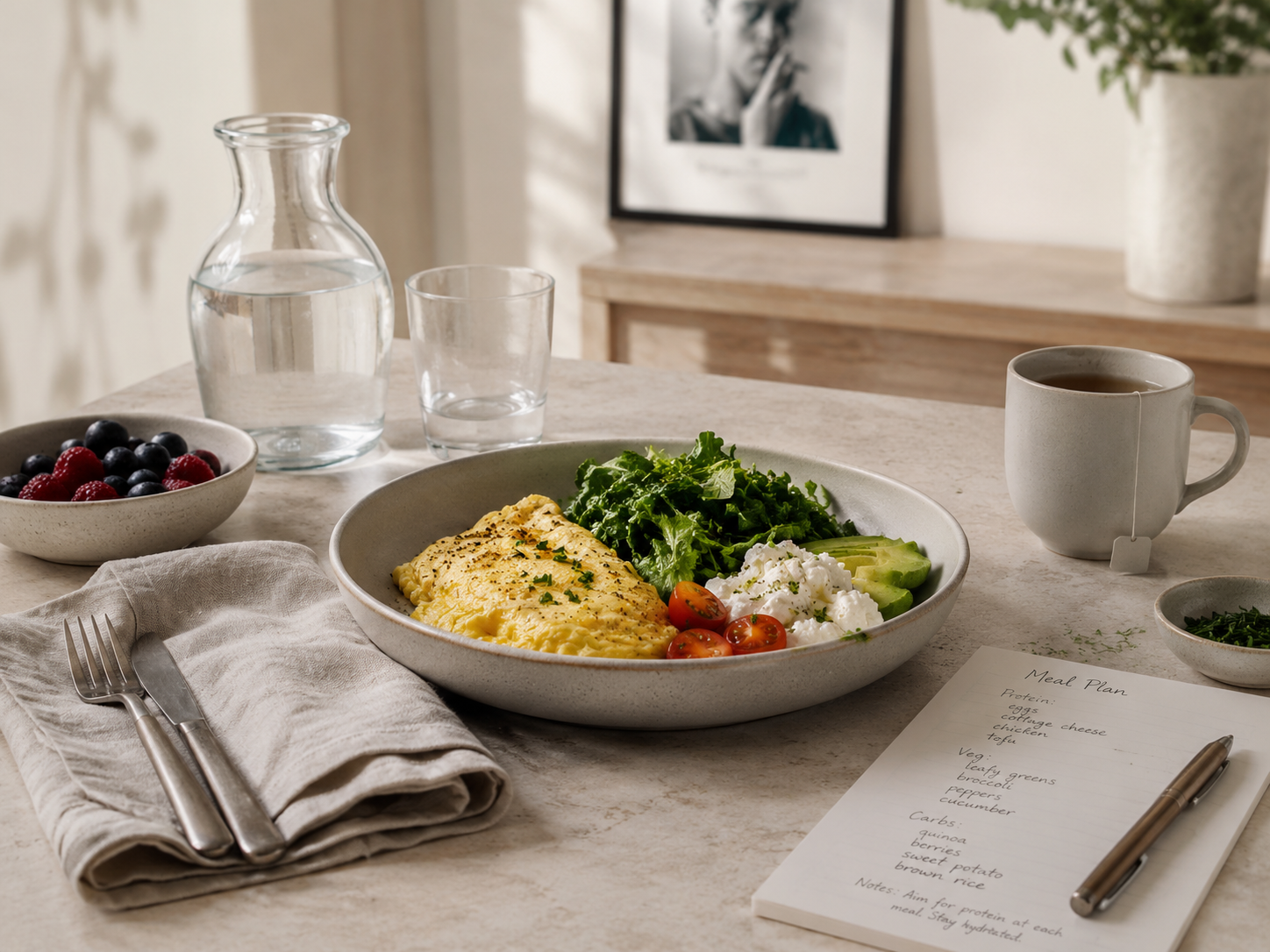
You bought the ingredients, made the meal and took three bites. Now the rest looks impossible. That can be frustrating when most weight-management advice assumes your main problem is wanting more food.
A useful response starts with the actual obstacle. Are you forgetting meals because hunger is quieter? Feeling full unusually quickly? Feeling nauseated? Finding food unappealing? Those situations can look similar on a food diary, but they need different conversations. This guide helps you organise the food side while making clear where clinical support belongs.
“GLP-1” is used here as a practical umbrella for medicines including semaglutide and liraglutide, and the related dual GIP/GLP-1 medicine tirzepatide. The suggestions are for adults. They are not a nutrition plan for children, pregnancy or a medical condition requiring a specialist diet.
How much protein do you need on GLP-1 treatment?
There is no single evidence-established protein target for every GLP-1 user. A 2025 joint professional advisory discusses proposed targets of 1.2–1.6 g/kg/day during active weight reduction, while noting uncertainty about which body weight to use in people with obesity. Using actual weight can overestimate requirements. This is expert guidance drawing on broader evidence, not a trial proving one target for everyone. Joint nutrition advisory, Obesity (2025)
If a clinician or dietitian has given you a target, ask what it is based on and how to make it workable. If you have kidney disease or another condition affecting nutrition, seek personalised advice before adopting a high-protein target. The hospital guidance also specifically directs people with chronic kidney disease to their dietitian. Guy’s and St Thomas’ NHS: food and nutrition
| Assumption | Calculation | Result |
|---|---|---|
| A professional selects 80 kg as the reference weight and 1.2 g/kg as the lower end | 80 × 1.2 | 96 g/day |
| The same reference weight at 1.6 g/kg | 80 × 1.6 | 128 g/day |
That is 96–128 g, not 95–125 g. More importantly, the calculation only becomes relevant after deciding whether its assumptions fit the person. Do not multiply your weight by an internet target and treat the answer as a personalised prescription.
How can you build a smaller meal without leaving everything out?
Think of the first serving as a manageable starting portion, with more available if wanted. This can be less daunting than presenting yourself with an oversized plate and feeling you have failed when you cannot finish it.
Our original planning prompt is: protein, something for energy, and another food for variety. It is a memory aid, not a validated nutrition method or a complete assessment of a meal. For example, that might mean egg on toast with tomatoes, or tofu with rice and cooked vegetables. What matters is whether it fits your needs and tolerance.
The general Eatwell pattern includes starchy foods, fruit and vegetables, protein foods, dairy or alternatives, and small amounts of unsaturated oils. Balance can be considered across a day or week. You do not need to remove carbohydrates simply because protein has become a priority. NHS: the Eatwell Guide
| If this feels manageable | Try assembling | Practical detail |
|---|---|---|
| A soft breakfast | Yoghurt or a suitable alternative, oats and fruit | Check the label: plant alternatives vary considerably in protein. |
| A small savoury meal | Egg or tofu, toast and a vegetable you enjoy | Serve a smaller amount first; keep the rest safely for later if needed. |
| Minimal preparation | Ready-to-eat beans or fish with bread and vegetables | Choose foods that fit allergies, preferences and storage arrangements. |
| A family dinner | A small serving of the family’s protein food, rice or potato, and vegetables | You can change your serving size without cooking a separate “GLP-1 meal”. |
These are combinations, not nutritionally complete menus or treatment for nausea. If a food makes symptoms worse, do not force it because a table calls it a good choice. If the range of foods you can tolerate keeps narrowing, take that information to your care team.
How do you calculate protein from a food label?
First check whether the label gives protein per 100 g, per serving or per container. Then check how much you actually ate. Confusing those units is an easy way to overestimate intake, particularly with a large tub or a packet containing two servings.
Here is an original arithmetic example using assumed labels. These are illustrative product values, not measured foods or recommendations for particular brands.
| Food | Assumed label | Amount eaten | Protein counted |
|---|---|---|---|
| Yoghurt | 10 g per 100 g | 150 g | 10 × 1.5 = 15 g |
| Tofu | 12 g per 100 g | 125 g | 12 × 1.25 = 15 g |
| Milk or suitable drink | 3.5 g per 100 ml | 200 ml | 3.5 × 2 = 7 g |
| Cooked chicken product | 30 g per 100 g | 80 g | 30 × 0.8 = 24 g |
| Subtotal | 15 + 15 + 7 + 24 | 61 g | |
The subtotal is not a daily target, a full day’s menu or evidence that a day is nutritionally adequate. Other foods would contribute additional protein and nutrients. Use the figures on your own packet; do not substitute the milk example for a plant drink unless its label actually matches.
If you eat half of the 150 g yoghurt portion in this example, the amount is 75 g and the protein is 7.5 g. Counting the full 15 g because that was what you served would misrepresent what you ate. You need not weigh every mouthful indefinitely. The point of this example is to understand labels well enough to make a useful estimate when needed.
Do you need protein shakes or supplements?
A shake can be a convenient food option when ordinary food is difficult, but a product labelled “protein” is not automatically a complete meal. Look at what the product actually supplies, its serving size, allergens, cost and how it fits your clinician’s advice.
Before buying a large tub, work out the practical problem you want it to solve. Is breakfast difficult to prepare? Is chewing or a food texture unappealing? Are you falling short of an agreed target? Or are you hoping a supplement will compensate for barely eating? That last situation needs a wider assessment.
One useful purchasing test is to write the proposed job on the shopping list: “a convenient option for the days I cannot prepare breakfast”. If the product does not perform that job at a price you can afford, a bigger marketing claim will not make it more useful. A dietitian can help distinguish ordinary food supplements from products used for clinical nutritional support.
Do not start a collection of vitamins, minerals or powders simply because you feel tired. Symptoms alone cannot identify which nutrient, if any, is lacking. Bring your current supplements to a pharmacist or clinician so that advice accounts for everything you already take.
What if you forget to eat because hunger is quiet?
Make eating opportunities visible in the day you actually have. A phone reminder is only useful if food and a break are available when it goes off. For someone travelling between appointments, a packed option and an agreed break may matter more than a beautifully organised meal plan at home.
Try an original three-part planning note:
- When: identify a realistic opportunity before work, during a break or after getting home.
- What: name one manageable food combination you already tolerate.
- Backup: decide what you will use if preparation falls through.
For example: “Lunch is during the 12.30 break. I will bring yesterday’s rice and tofu. If there are no leftovers, I will use the sandwich ingredients already in the fridge.” This is deliberately ordinary. The purpose is to reduce the number of decisions between noticing a need and having food available.
If reminders do not help because you feel physically unable to eat, that is different from forgetting. Contact your prescriber rather than setting more alarms and trying to push through.
Does eating more protein prevent muscle loss?
Protein alone cannot guarantee muscle preservation. The joint advisory emphasises the combination of nutrition and resistance exercise. It also distinguishes the need to assess function and strength, rather than judging everything by body weight. Joint nutrition advisory, Obesity (2025)
For your own review, a useful question is: “Am I able to do the things I need and want to do?” If carrying shopping, rising from a chair or a familiar activity is becoming harder, tell your clinician. Those observations do not diagnose muscle loss, but they give the appointment a concrete starting point.
A bathroom scale’s body-composition estimate is not a diagnosis either. Avoid reacting to one percentage by buying supplements or suddenly increasing exercise. Ask how strength and nutrition should be assessed in your circumstances.
When does low intake need medical help?
Repeated vomiting, inability to keep fluids down, markedly reduced urine or persistent dizziness on standing warrant prompt medical advice. Confusion, difficulty breathing or being difficult to wake require emergency help. NHS: dehydration
If you use insulin or a sulfonylurea, missed meals or reduced carbohydrate intake can contribute to low blood glucose. Follow your established diabetes plan and ask your team how to manage days when eating is difficult. NIDDK: low blood glucose
For ongoing low intake without urgent symptoms, bring a short account of what you have managed to eat and drink, what gets in the way and when the problem began. Ask whether medication tolerability, nutrition assessment or dietetic support needs review. Do not wait until your record looks complete before contacting someone.
Questions readers ask
Should I force myself to finish a large meal?
A large plate is not the only way to organise food. Smaller, manageable opportunities can be more practical. If you cannot eat adequately, get help with the reason rather than treating finishing the plate as a test of determination.
Is 100 g of chicken the same as 100 g of protein?
No. One is the weight of the food; the other is the amount of a nutrient. The worked label example above keeps those units separate.
Can a vegan eating pattern include enough protein?
It can be planned around suitable protein foods, but a low appetite or restricted food range can make planning harder. Seek dietetic help with overall adequacy rather than assuming a single substitute covers every nutrient.
Is losing interest in food the goal?
Not at the expense of adequate eating or quality of life. Tell your care team if food has become consistently difficult, distressing or impossible to enjoy.
Sources and editorial scope
Sources checked on 11–12 September 2026. Research findings, official guidance and original planning examples are identified separately. This is an editorial evidence check, not independent clinical review.